
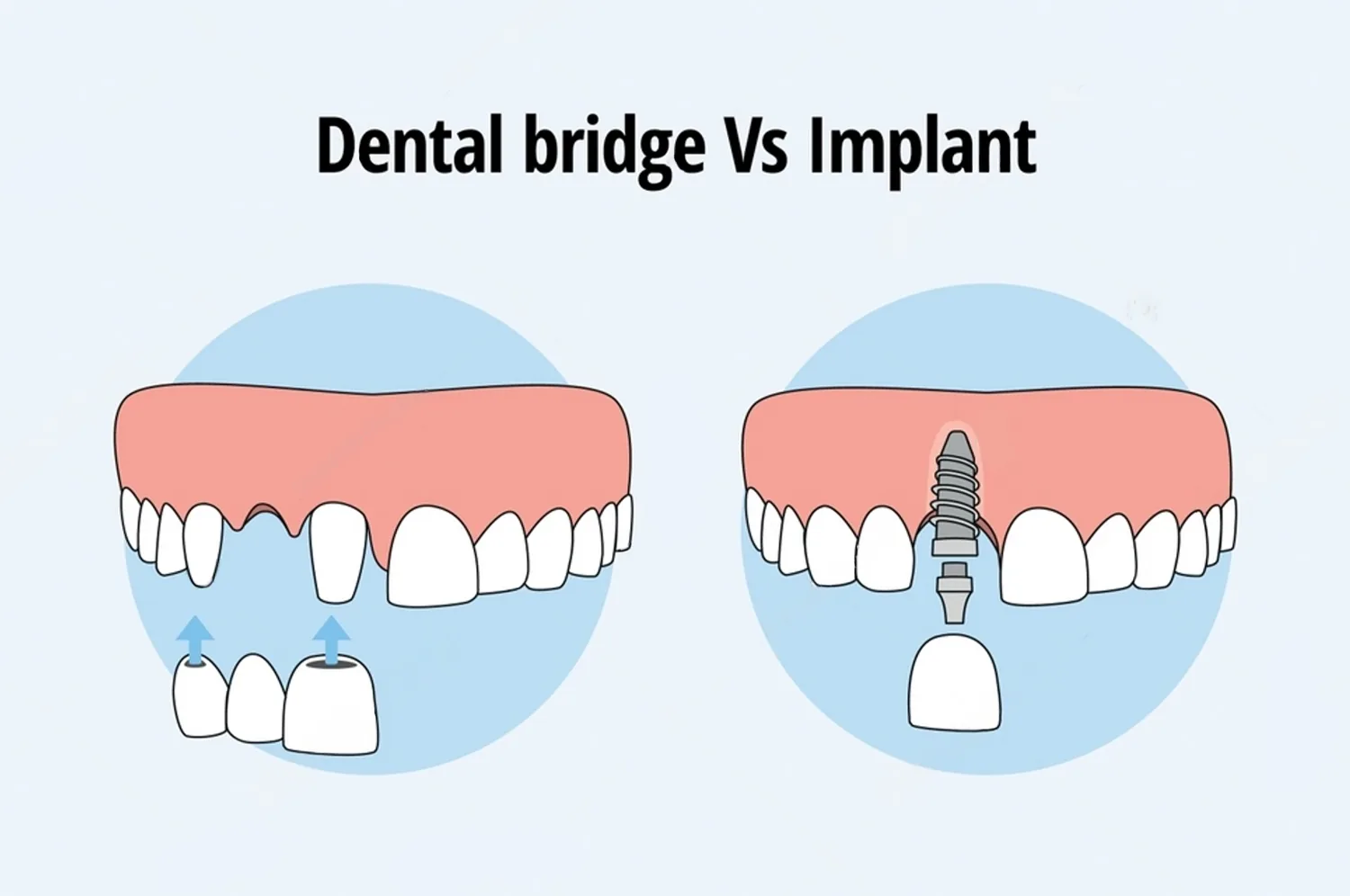
Dental bridge vs dental implant: both replace a missing tooth, but a bridge leans on nearby teeth while an implant stands alone. Here is how they compare. The right choice depends on your teeth, your bone and your goals.
Losing a tooth affects more than your smile. It can make chewing harder, let nearby teeth drift into the space and, over time, allow the jawbone under the gap to shrink. At Southern York Smile Care in Shrewsbury, PA, Dr. Steven Haywood, DDS, helps patients weigh both options so they can choose with confidence.
How a dental bridge works
A traditional dental bridge is a row of connected crowns. The teeth on each side of the gap are shaped and covered with crowns, and those crowns hold a false tooth, called a pontic, that fills the space. The bridge is cemented in place and does not come out.
Bridges have restored smiles for generations, and they still have a place. A bridge:
- Is usually finished in a few weeks, with no surgery.
- Can be a good fit when the teeth next to the gap already need crowns.
- Works when bone or health conditions make implant surgery a poor choice.
The trade-offs of a bridge
The biggest drawback is that healthy neighboring teeth have to be reshaped to hold the bridge. Those anchor teeth then carry extra load. The area under the false tooth can also be hard to clean, and plaque that collects there raises the risk of decay and gum disease on the anchor teeth. If an anchor tooth develops a problem, the whole bridge may need to be replaced. A bridge also does nothing to stimulate the bone under the missing tooth, so that bone can slowly shrink.
How a dental implant works
A dental implant replaces the missing root as well as the visible tooth. A small post is placed in the jawbone, where it bonds with the bone over a few months. A connector and a crown are then attached to the post. Implants are most often made of titanium, and ceramic implants are another option for some patients. Our article on ceramic vs titanium implants explains the difference.
The key advantages:
- Your other teeth stay untouched. An implant stands on its own, so the neighboring teeth do not need crowns. In that sense it is the more conservative choice.
- It helps preserve bone. Because the post sits in the jaw, chewing forces pass into the bone, which helps keep it from shrinking the way it does under a gap.
- It cleans like a natural tooth. You brush and floss around an implant much as you would a real tooth.
- The implant itself cannot decay. The gums and bone around it still need care, but there is no tooth structure to get a cavity.
- It can last a very long time. Research shows implants have high long-term success rates when patients keep up good home care and regular checkups.
The trade-offs of an implant
Implants involve a minor surgical procedure and a healing period of a few months before the final tooth is attached. You need enough healthy bone to hold the post. If bone has been lost, bone grafting can often rebuild it first, which adds time. Health conditions such as uncontrolled diabetes and habits such as smoking can affect healing, so they are part of the discussion.
Side-by-side comparison
- Effect on neighboring teeth: A bridge requires crowning the teeth beside the gap. An implant leaves them alone.
- Bone under the gap: A bridge does not stimulate it. An implant helps preserve it.
- Cleaning: A bridge needs a floss threader or special brush under the false tooth. An implant is cleaned much like a natural tooth.
- Treatment time: A bridge usually takes a few weeks. An implant usually takes a few months, longer if bone grafting is needed.
- Surgery: None for a bridge. A minor procedure for an implant.
- Long-term outlook: Bridges often need replacing eventually, especially if an anchor tooth has problems. Implants can last for many years with good care.
Replacing more than one tooth
The choice is not always one or the other. When several teeth in a row are missing, an implant bridge uses two or more implants to support a bridge, so no natural teeth are involved. For a single missing tooth, a single-tooth implant is the usual approach. When most or all teeth are missing, options such as All-on-4 implants or snap-on implant teeth can replace a whole arch.
How Dr. Haywood plans implant treatment
Dr. Haywood is a Fellow of the International Congress of Oral Implantologists, with more than 35 years in practice. Planning starts with a close look at your bone. The Green CT 3D cone beam scanner shows bone height, width and nearby nerves and sinuses in three dimensions, and the iTero Element 3D scanner records your teeth and bite digitally. With that information, guided implant surgery uses a custom guide to place each implant in the planned position. You can see more on our dental technology page.
If you feel nervous about surgery, oral sedation is available to help you relax.
Which is right for you?
An implant is often the better long-term choice when the teeth next to the gap are healthy and there is enough bone, or bone can be rebuilt. A bridge may make more sense when those teeth already need crowns, when surgery is not a good option, or when you need a faster solution. The best way to decide is an exam that looks at your teeth, gums, bone and bite together.
What if you wait?
Leaving a gap is also a choice, and it has costs of its own. Neighboring teeth can tip into the space, the opposing tooth can drift toward it, and the bone underneath slowly thins. Those changes can make either a bridge or an implant more involved later. If you are not ready to decide, an exam can at least show how quickly things are changing.
Paying for tooth replacement
Southern York Smile Care is out of network with every insurer. You pay at the visit, and the office files the claim with your insurance company for reimbursement. CareCredit and Cherry payment plans can spread the cost over time. Kelley Fisher, our Patient Care and Treatment Coordinator, can walk you through your plan and options. See our financing page for details.
Talk with us about replacing a missing tooth
Whether you choose a bridge or an implant, replacing a missing tooth protects your bite and your smile. Southern York Smile Care is at 4 S. Main St in Shrewsbury, PA, and serves York, southern York County and northern Baltimore County, MD. Call (717) 235-3871 or request an appointment to talk with Dr. Haywood.

DDS cum laude 1987, US Air Force residency, NYU cosmetic training and Fellow of the International Congress of Oral Implantologists, with 35+ years in practice.
Meet Dr. Haywood → Coronation: Dental Crowns in Shrewsbury PA
 Dental Implants in York: Replace Missing Back Teeth!
 Beautiful Smiles in Shrewsbury PA!