
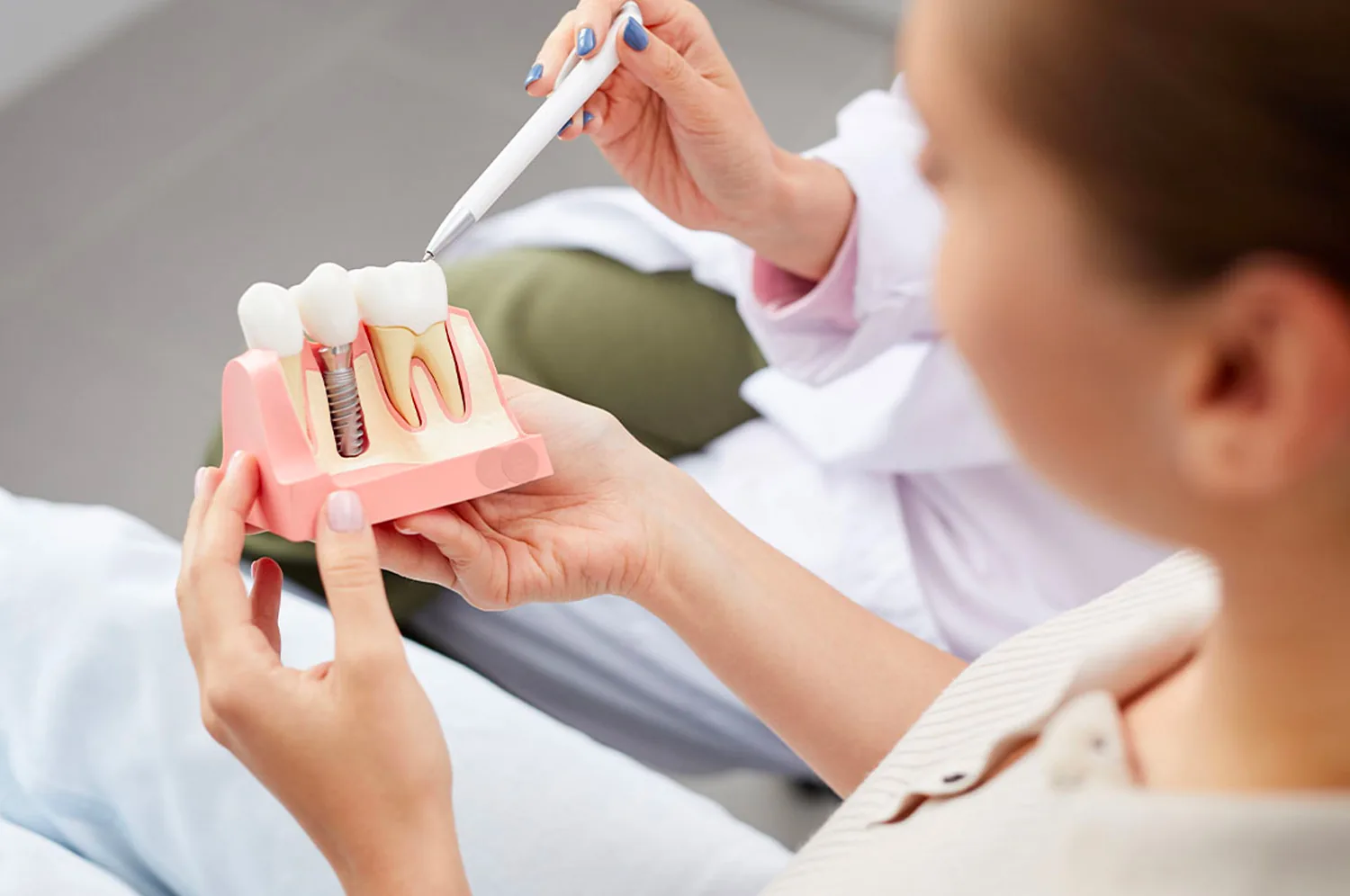
Guided implant surgery uses a 3D scan and a custom surgical guide to place each dental implant exactly where it was planned. At Southern York Smile Care in Shrewsbury, PA, it is a cornerstone of how Dr. Steven Haywood plans and places implants.
If you are thinking about a dental implant, you will hear a lot about the tooth on top: its color, its shape, how natural it looks. What happens underneath matters just as much. An implant is only as good as its position in the bone. This article explains how 3D imaging and guided placement work, why they matter, and what to expect if you are a candidate.
What is guided implant surgery?
A dental implant is a small titanium post that replaces the root of a missing tooth. Once it bonds with the jawbone, it supports a crown, a bridge or a full set of teeth. To do that job well for many years, the implant needs to sit in healthy bone, at the right depth and angle, and in the right spot for the tooth it will hold.
In freehand placement, the surgeon relies on two-dimensional X-rays, experience and what can be seen during surgery. In guided implant surgery, the whole procedure is planned first on a 3D model of your jaw. A custom guide, made from that plan, then steers the drills during surgery so the implant goes exactly where the plan says it should.
Why implant position matters so much
Dental implants have a strong track record. Research shows that well-placed implants in healthy bone succeed in the large majority of cases. Many problems that do arise come back to position: an implant set at the wrong angle, too close to a nerve or a neighboring root, or in bone that was too thin to support it.
A poorly placed implant can be hard to fix. If the surrounding bone is lost, the area may need grafting before a new implant can go in. In the front of the upper jaw, the smile zone, an implant that sits too far forward or too high can leave a crown that looks too long or shows a gray edge at the gumline. Dr. Haywood also sees patients who come in for help with implants placed elsewhere that have failed or do not look right.
Careful digital planning is the best way to avoid those problems in the first place. That is why it sits at the center of implant care at Southern York Smile Care.
Step one: a 3D scan with cone beam CT
A standard dental X-ray is a flat, two-dimensional picture. A cone beam CT, often called a CBCT, is a 3D X-ray. It captures your jaw from many angles, and computer software then rebuilds the bone into a model that can be turned and viewed from any side.
The practice uses a Green CT 3D cone beam scanner made by VATECH. Here is what the scan looks like from your side of the chair:
- It is quick. The scan takes about as long as a standard panoramic X-ray. You stand or sit still while the arm rotates around your head.
- The dose is low. A dental cone beam scan uses far less radiation than a medical CT scan in a hospital, and Green CT is designed with a low dose in mind.
- Results come fast. Within minutes, the software has rebuilt your facial bone structure in 3D.
The scan shows how much bone you have, how dense it is, and where nerves, sinuses and neighboring roots sit. If there is not enough bone where the implant needs to go, you will know at this visit. In that case, bone grafting can be planned as part of your care. You can read more about the scanner and our other tools on the dental technology page.
Step two: a virtual surgery before the real one
With your 3D model on screen, Dr. Haywood places a virtual implant in the software. The size, length, depth and angle can all be adjusted until the implant sits in the best bone, clear of nerves and roots, and lined up under the tooth it will support.
The practice can also take a digital impression of your teeth with the iTero Element 3D scanner. Combining that with the CBCT lets the plan account for both the bone and the final tooth, so the implant is placed with the finished smile in mind and not just the available bone.
This is also a good time for questions. You can see the plan on screen and understand exactly what is proposed and why.
Step three: the surgical guide and guided placement
Once you accept treatment, the digital plan goes to a dental lab that makes surgical guides. The lab uses it to 3D print a precise guide that fits snugly over your teeth or gums. Dr. Haywood reviews and approves the guide before it is used.
The guide has openings fitted with metal sleeves. These accept the drills from a guided surgery kit, and they control the position, angle and depth of each step. On the day of surgery, the implant goes in where the virtual surgery placed it. Making the guide usually takes a couple of weeks after the plan is approved.
Because so much is decided in advance, guided surgery can often mean a smaller opening in the gum and a smoother visit. If you are anxious, sedation dentistry with oral sedation is available to help you relax.
When a guide helps most
Guided implant surgery is especially useful when:
- there is very little bone and minimal room for error
- a specific angle is needed for the best result
- several implants need to sit nearly parallel to one another, as with an implant bridge or All-on-4 dental implants
- the implant replaces a front tooth, where appearance is critical
- the highest accuracy is needed near nerves or sinuses
Does every implant need a guide?
No. In some straightforward cases, an experienced surgeon can place an implant well freehand, using the 3D scan as a map. Dr. Haywood will recommend the approach that fits your mouth and explain why.
Experience behind the technology
Technology helps, but judgment matters most. Dr. Haywood is a Fellow of the International Congress of Oral Implantologists, completed an advanced residency with the US Air Force, and has more than 35 years in practice. That experience shapes every plan, from single tooth implants to full arches.
For a broader look at the whole process, see our article Dental Implants in York, PA: What to Expect.
Paying for implant care
Southern York Smile Care is out of network with every insurance company. You pay at the visit, and the office files the claim so your plan can reimburse you. Coverage for scans and guides varies by plan, and Kelley Fisher, the Patient Care and Treatment Coordinator, can help you understand your options. Payment plans are available through CareCredit and Cherry. See our financing page for details.
Your next step
If you are missing a tooth or have been told you do not have enough bone for an implant, a 3D scan can give you clear answers. Call Southern York Smile Care at (717) 235-3871 or request an appointment at 4 S. Main St in Shrewsbury. The practice serves patients from York, southern York County and northern Baltimore County, MD.

DDS cum laude 1987, US Air Force residency, NYU cosmetic training and Fellow of the International Congress of Oral Implantologists, with 35+ years in practice.
Meet Dr. Haywood → Porcelain Veneers and Instant Orthodontics for Shrewsbury
 4 Reasons to Look for the ADA Seal
 Don’t Use your Teeth as Tools!