
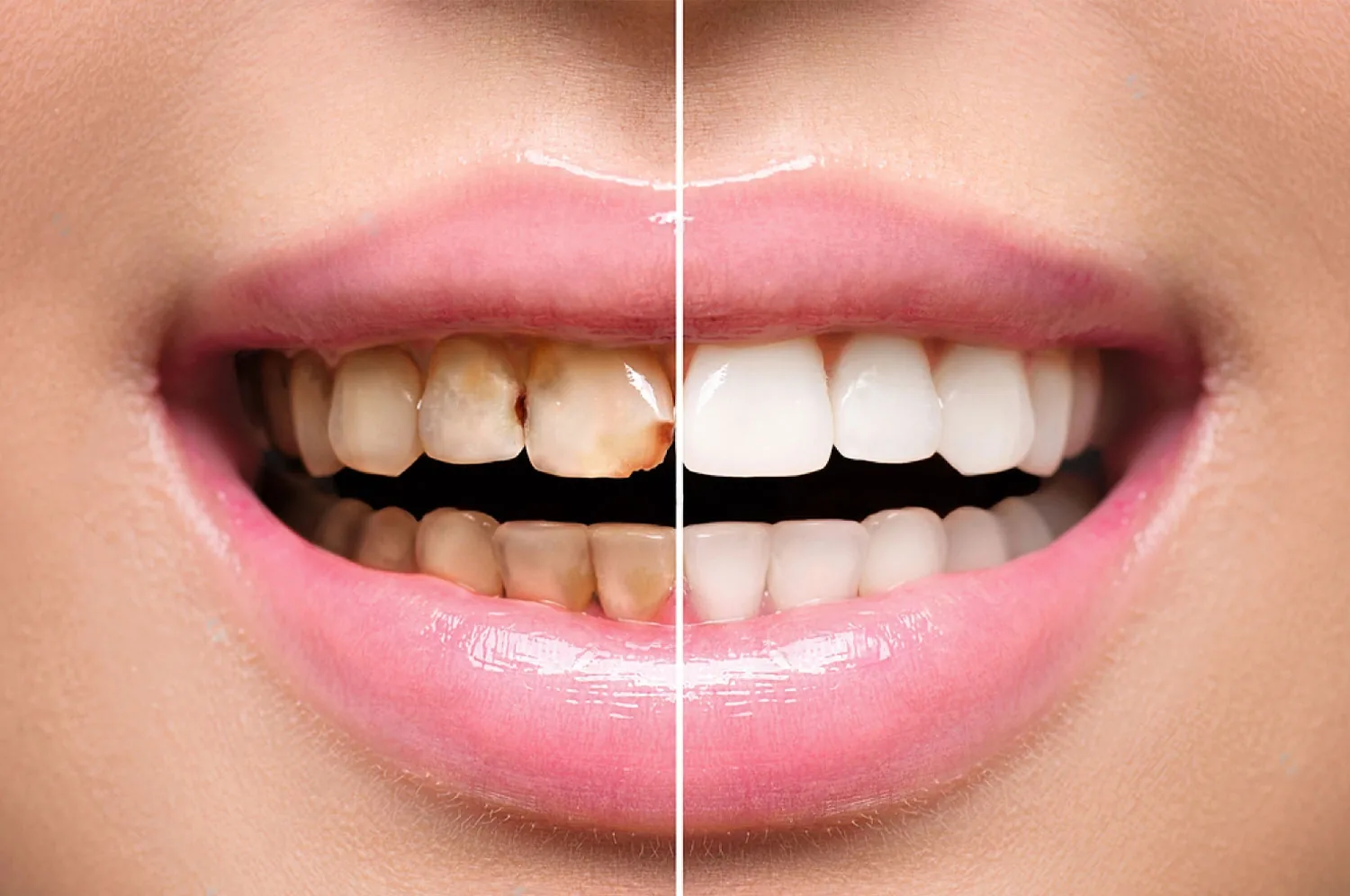
Restore or replace? A damaged tooth can often get new life from a filling, an onlay, bonding, a veneer or a crown, saving your own tooth. If not, an implant can replace it. There's more than one way to fix a tooth. If you have perfectly healthy teeth, you may never need any of these. But most people will need to repair a tooth at some point, and knowing your options makes the choice easier.
Restore or Replace: How Dentists Decide
The first question with any damaged tooth is whether it can be saved. In most cases, keeping your natural tooth is the better choice. Your own tooth keeps the bone around it healthy, holds its neighbors in place and feels completely natural when you bite.
Your dentist looks at several things to decide:
- How much healthy tooth is left. A tooth with a small cavity is easy to restore. One that's mostly filling, or broken below the gumline, may not be.
- Whether the nerve is healthy. An infected nerve can often be treated with a root canal before the tooth is restored.
- The health of the gums and bone. A tooth needs solid support to last.
- Cracks. A crack in the crown can often be repaired. A crack that runs down into the root usually means the tooth needs to be replaced.
- Your goals. Appearance, cost, time and how long you want the repair to last all matter.
Dr. Steven Haywood uses digital X-rays, an intraoral camera and, when needed, Green CT 3D imaging to see the whole picture. You'll see what your dentist sees, and you'll hear the pros and cons of each choice in plain language.
Ways to Restore a Damaged Tooth
When a tooth can be saved, there are several ways to rebuild it. They range from small, one-visit repairs to full coverage. The general rule is to choose the most conservative option that will last.
Porcelain veneers
Veneers are wafer-thin porcelain covers bonded to the front of a tooth. They're a cosmetic restoration, best for teeth that are healthy but chipped, cracked on the surface, stained or slightly crooked. A veneer can hide a chip and make a slightly crooked tooth look straight.
Veneers aren't meant for teeth with large fillings or heavy decay, since they only cover the front surface. Learn more on the porcelain veneers page, or read crown or veneer? to compare the two.
A filling, inlay or onlay
Fillings have been used to restore teeth for well over a century, though the materials have changed a great deal. Southern York Smile Care is a mercury-free office and places tooth-colored, BPA-free white fillings rather than silver amalgam. White fillings bond to the tooth, which often means less drilling.
If you have old metal fillings that are cracked or worn, replacing them with white fillings is one option to discuss. See white dental fillings and mercury-free dentistry.
When a cavity or old filling is too large for a regular filling, an inlay or onlay may be a good middle ground. These are made outside the mouth to fit precisely, then bonded in. That's why they're often called indirect fillings.
- Inlays fit inside the cusps of a back tooth, in the center of the chewing surface.
- Onlays also cover one or more cusps, adding strength to a weakened tooth.
Both save more natural tooth than a crown.
Dental bonding
Bonding uses tooth-colored composite resin, shaped directly on the tooth. It can repair chips and cracks, cover stains, close small gaps and make short teeth longer. The resin is applied in layers, sculpted to the right shape and hardened with a special curing light.
Bonding is usually done in one visit and keeps almost all of your natural tooth. It's often the most affordable cosmetic repair, though resin isn't as strong or stain-resistant as porcelain. Learn more on the cosmetic bonding page or read about this affordable one-visit tooth fix.
A dental crown
A crown covers the entire visible part of a tooth. It restores shape, strength and appearance when a tooth is too damaged for a filling or onlay. Crowns are used:
- After a root canal, especially on back teeth.
- On teeth with large areas of decay or very large old fillings.
- On cracked teeth, to hold the tooth together.
- As the anchor teeth of a dental bridge.
- As the visible tooth on top of a dental implant.
Crowns can be made from metal, porcelain fused to metal or all-ceramic materials. All-porcelain crowns have no metal edge to show at the gumline. See all-porcelain crowns for more.
When It's Time to Replace: Dental Implants
When a tooth can't be saved, the best replacement is often a dental implant. Many dentists consider it the most complete restoration, because it replaces both the root and the crown. A small post is placed in the jawbone, where it fuses with the bone. A crown is then attached on top.
Implants have several advantages:
- They look and feel very much like natural teeth.
- They don't need neighboring teeth to be shaped, unlike a traditional bridge.
- They help prevent the bone loss that usually follows an extraction.
- They can also anchor bridges and dentures when several teeth are missing.
Replacing a lost tooth promptly matters. When a gap is left open, nearby teeth can drift and the bone can shrink, which can make later treatment more involved. If an extraction is planned, ask whether the implant can be planned at the same time. In some cases, a bone graft placed when the tooth is removed helps preserve the site.
Dr. Haywood is a Fellow of the International Congress of Oral Implantologists. Learn more on the single tooth implant and dental implants pages. If you're comparing options, read dental bridge vs. dental implant.
Protecting Your Repairs
Whether you restore or replace a tooth, good habits help it last:
- Brush twice a day and clean between your teeth daily.
- Keep your checkups. Cleanings at the office are a full 60 minutes, with time to check every restoration.
- Wear a night guard if you grind or clench.
- Don't chew ice, hard candy or pens, or use your teeth to open things.
For more on the full range of repairs, see restorative dentistry or our article 7 ways to fix a tooth.
Southern York Smile Care is out of network with every insurer. You pay at the visit and the office files the claim so you can be reimbursed. CareCredit and Cherry payment plans are available. Kelley Fisher, the Patient Care and Treatment Coordinator, can explain your plan and your choices. See the financing page.
Give Your Tooth New Life
If you have a damaged tooth and want to know whether it can be saved, call Southern York Smile Care at (717) 235-3871 or request an appointment. The office is at 4 S. Main St in Shrewsbury and welcomes patients from York, southern York County and northern Baltimore County. Read more about Dr. Haywood on the meet the doctor page.

DDS cum laude 1987, US Air Force residency, NYU cosmetic training and Fellow of the International Congress of Oral Implantologists, with 35+ years in practice.
Meet Dr. Haywood → Is Cosmetic Dentistry for You?
 Dr. Steven W. Haywood Dental Miracles
 Celebrity Smiles in Shrewsbury